
Structured Interview Scorecard: How Small Teams Compare Candidates Fairly
Structured Interview Scorecard: How Small Teams Compare Candidates Fairly. The rest of this page is that guide, written for a small team.
Qonir Team · 8 min read
Small teams often hire after three or four relaxed conversations and a gut feeling. The trouble is that gut feelings are hard to compare. One interviewer remembers the candidate who made them laugh, another remembers the one with the famous employer, and the debrief turns into a debate about impressions. A structured interview scorecard fixes this without turning your hiring into a bureaucracy. This guide explains what a scorecard is, how to build one in an afternoon, and how three finalists for a customer support role can be compared fairly with it.
Why unstructured interviews are hard to compare
In an unstructured interview, each candidate gets different questions, in a different order, judged against criteria that only exist in the interviewer's head. Three problems follow.
You cannot compare answers. If candidate one was asked about a difficult customer and candidate two was asked about their favourite tools, nobody can say who answered better.
First impressions dominate. People decide quickly and then spend the rest of the conversation collecting evidence for their first impression.
Debriefs reward the loudest voice. Without written scores, the most senior or most confident person in the room often sets the outcome before others have spoken.
None of this means interviewers are careless. It means a conversation without a shared yardstick is the wrong tool for comparing people. A scorecard supplies the yardstick.
What a structured interview scorecard is
A structured interview scorecard is a one-page sheet that lists the few competencies the job really needs, one question for each, and a rating scale with a plain-language description of every score. Each interviewer fills it in for every candidate, using the same questions and the same scale.
It is not a form that replaces judgment. The interviewer still listens, follows up and decides what they believe. The scorecard simply forces them to write down what they heard, against criteria agreed before the first interview.
Three properties make it work:
The criteria come from the job, not from the interviewer's taste.
Every score has an anchor, a short description of what that score looks like in an answer.
Scores are recorded individually, before the team talks.
Step 1: pick four competencies from the job
Start from the job description, not from a generic list of "soft skills". If the posting says the person will answer customers in writing, handle escalations and own the help centre, those tasks suggest what to measure. For a team of a dozen, four competencies are enough. More than that and interviewers run out of time to probe any of them properly.
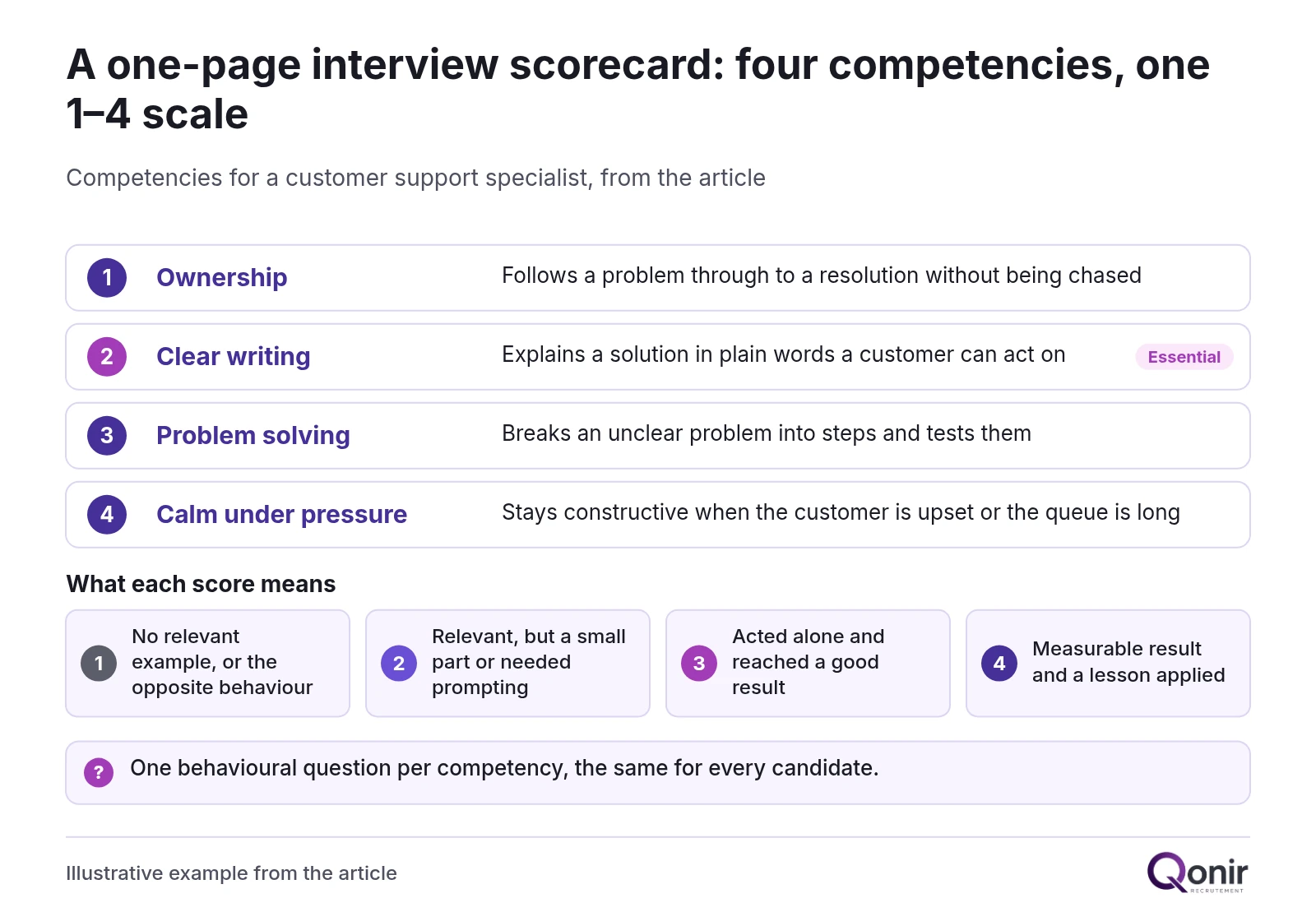
For the customer support example in this article, the four competencies are:
Ownership: follows a problem through to a resolution without being chased.
Clear writing: explains a solution in plain words that a customer can act on.
Problem solving: breaks an unclear problem into steps and tests them.
Calm under pressure: stays constructive when the customer is upset or the queue is long.
Mark which competency is essential for the role. For customer support, clear writing is essential, because almost the entire job happens in written messages. You will use that mark later to break ties.
Step 2: write one question and anchors per competency
For each competency, write one behavioural question: ask about something the candidate actually did, rather than what they would hypothetically do. "Tell me about a time a customer's problem took several days to solve. What did you do each day?" tells you more about ownership than "Are you a proactive person?"
Then write anchors on a four-point scale, so interviewers do not need to invent their own meaning for each number:
1: no relevant example, or the example shows the opposite behaviour.
2: a relevant example, but the candidate played a small part or needed to be prompted.
3: a clear example where the candidate acted on their own and reached a good result.
4: a strong example with a measurable result, plus a lesson the candidate applied afterwards.
Use the same four-point scale for every competency. An even number of points is deliberate, as it removes the comfortable middle score that interviewers pick when they are unsure. The figure below shows the layout of a one-page scorecard for this role.
Worked example: three finalists for a customer support specialist
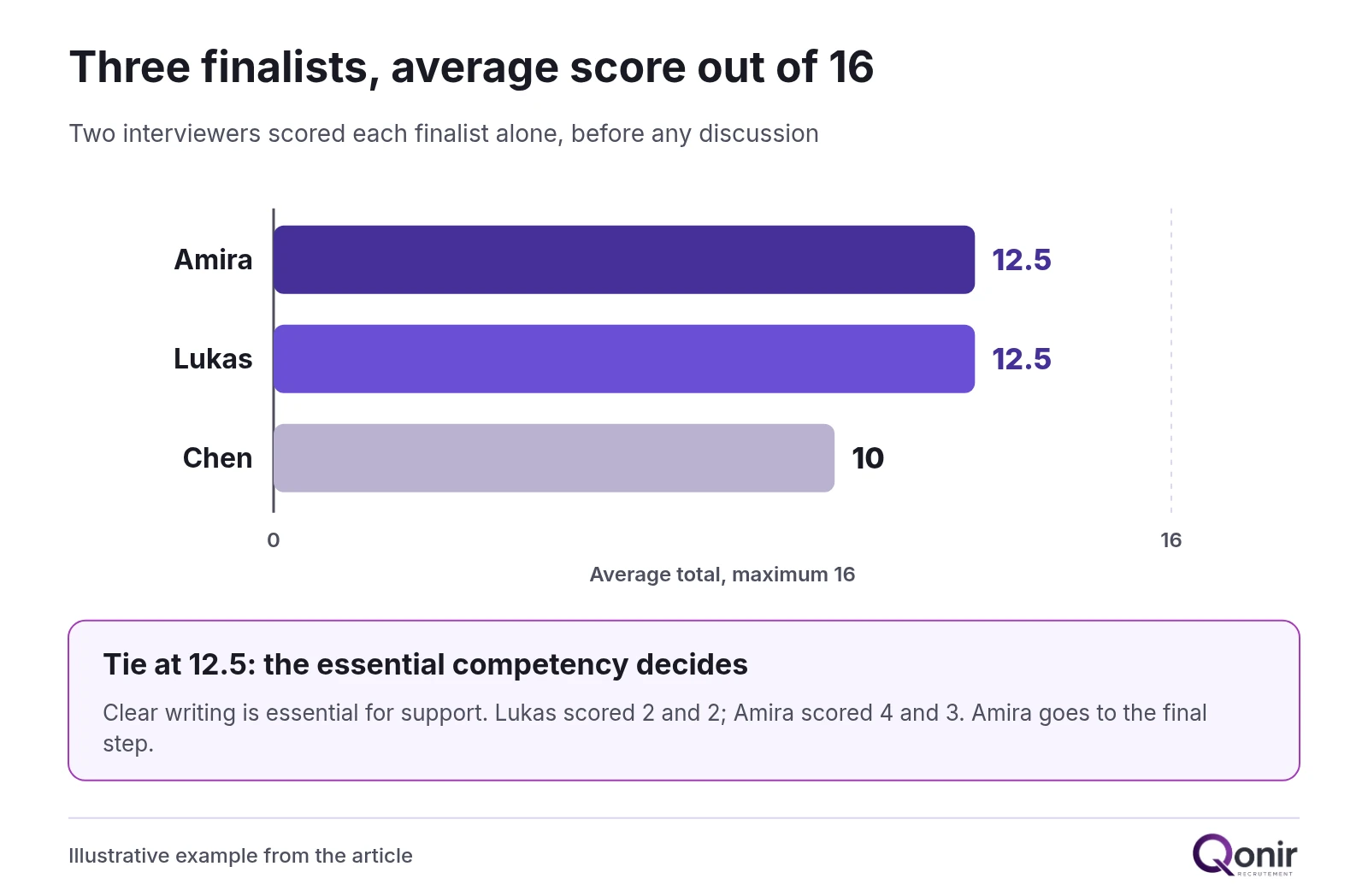
The example is illustrative, not real client data. A 12-person company hires a customer support specialist. Three finalists, Amira, Lukas and Chen, each have a 45-minute structured interview with two interviewers. Each interviewer asks the same four questions and scores the four competencies from 1 to 4, so the highest possible total is 16.
Here are the totals each interviewer wrote down before any discussion.
Amira: interviewer one scored 13 (3, 4, 3, 3) and interviewer two scored 12 (3, 3, 3, 3). Average: 12.5.
Lukas: interviewer one scored 12 (4, 2, 3, 3) and interviewer two scored 13 (4, 2, 3, 4). Average: 12.5.
Chen: interviewer one scored 10 (2, 3, 2, 3) and interviewer two scored 10 (3, 3, 2, 2). Average: 10.
The score order is ownership, clear writing, problem solving and calm under pressure. Amira and Lukas tie at 12.5 out of 16, and Chen is at 10. In an unstructured debrief that tie would turn into an argument about who "felt" better. With the scorecard, the team looks at the competency marked essential. Lukas scored 2 on clear writing from both interviewers, while Amira scored 4 from one and 3 from the other. Since writing is the essential competency for customer support, Amira goes forward to the final step, and the team can tell Lukas exactly what the decision rested on.
Note that Lukas is not a weak candidate. He scored 4 on ownership from both interviewers. A different role, such as an account manager who works mostly by phone, might rank him first. The scorecard does not say who is the better person. It says who fits this job better, with reasons anyone can read.
Step 3: score alone first, then debrief
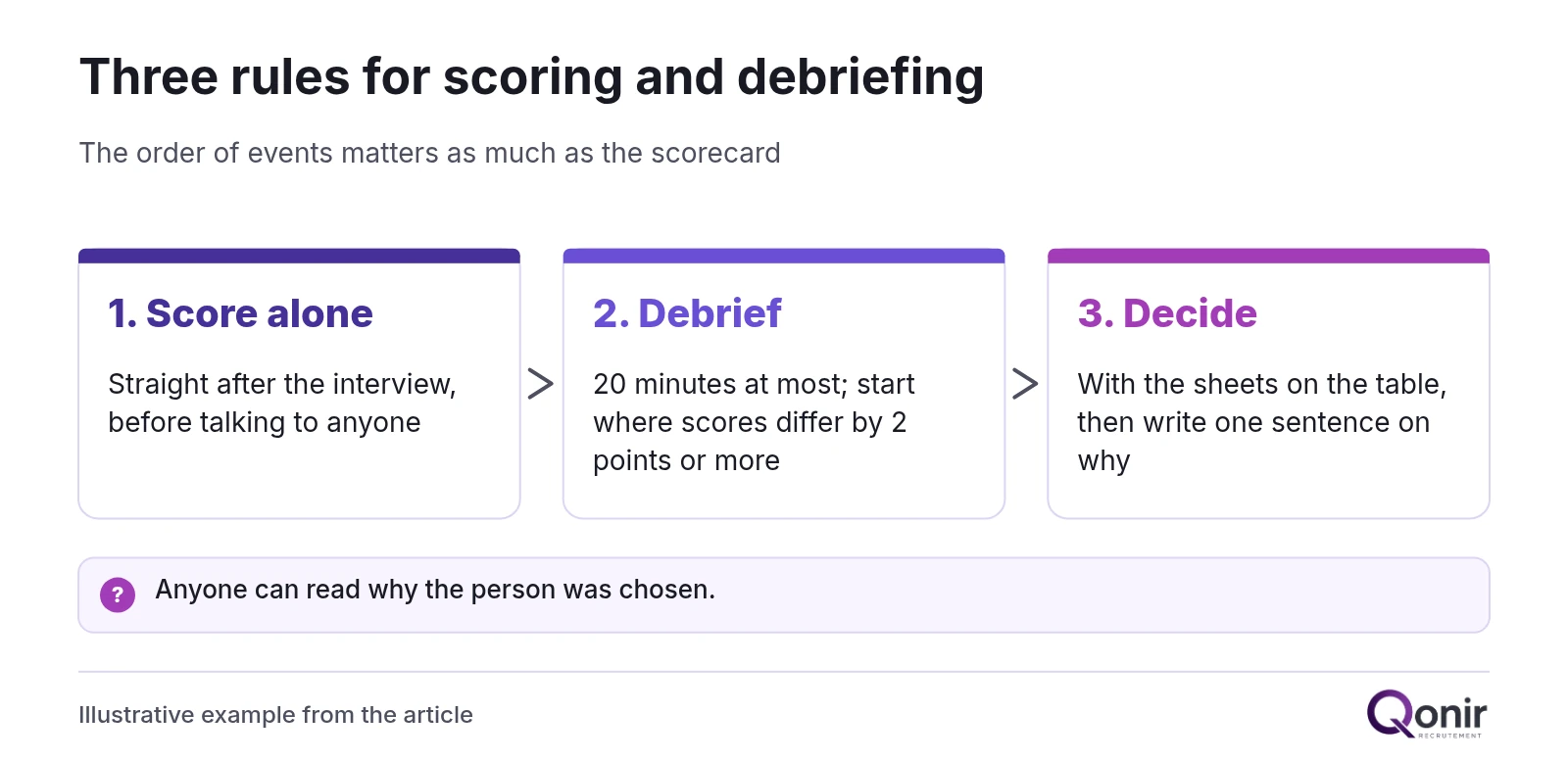
The order of events matters as much as the content of the card. Use three rules.
Score straight after the interview, alone, before talking to anyone. This protects each interviewer's independent view.
Debrief for no more than 20 minutes. Start with the competencies where two interviewers differ by 2 points or more, since that is where one of them probably heard something the other missed.
Decide with the sheets on the table. Add up the totals, look at the essential competency, and write one sentence on why you chose the person.
In the example, no pair of scores differs by 2 or more points, so the debrief goes straight to the tie-break. In a real process you will often find one gap, and talking it through is the most useful part of the meeting. You may discover that one interviewer asked a follow-up question that changed the answer, which is a signal to add that follow-up to the written question for the next candidate.
Common mistakes to avoid
Most scorecards fail in the same few ways.
Too many competencies. More than five makes each interview shallow and the scorecard tedious to fill in.
Anchors that nobody agreed on. If interviewers define a 3 differently, you are back to comparing impressions, only with numbers on them.
Changing questions between candidates. A tailored follow-up is fine, but the core question stays the same, or the scores stop being comparable.
Averaging away a dealbreaker. If a competency is essential, treat a low score on it as a flag even if the total looks strong.
Skipping the written reason. A number without one sentence of evidence is hard to defend later, and hard to learn from.
Keep every scorecard after the decision. They show which questions actually separated candidates, and they give you a documented, consistent process if anyone asks how a choice was made.
Next steps
You can build your first scorecard in an afternoon. Take the job description, choose four competencies, write one behavioural question and four anchors for each, and share the sheet with every interviewer before the first candidate comes in. If the job description is still vague, start there with the Qonir job description page (https://qonir.com/en/job-description), because a clear role makes a clear scorecard.
The scorecard also pairs well with an earlier screening step. Candidate matching shows why each applicant ranks where they do, which helps you choose who to interview (https://qonir.com/en/blog/candidate-matching-explainable-ranking-guide). If you are comparing tools for managing the whole pipeline, read the guide to the best ATS for small business (https://qonir.com/en/blog/ats-for-small-business-hiring-guide), then check the Qonir pricing page (https://qonir.com/en/pricing). More hiring guides are on the Qonir blog (https://qonir.com/en/blog).
FAQ
What is a structured interview scorecard?
A one-page sheet listing the few competencies a job needs, one question for each, and a rating scale with a plain-language anchor for every score. Every interviewer uses the same sheet for every candidate.
How many competencies should a scorecard have?
Four works for most small-team roles. More than five makes each interview shallow and the sheet tedious to fill in.
Why should interviewers score before they talk?
Scoring alone, straight after the interview, keeps each person's view independent, so the debrief is not decided by the loudest or most senior voice.
Qonir Team
Editorial
Insights from the Qonir team on modern recruiting for SMBs.
Published · 8 min read
Related articles
Account Manager Job Description: Responsibilities, Skills and Salary
A practical account manager job description: ten core responsibilities, salary ranges from live postings, required and desired skills, career path and a template you can copy.
7 min
Recruitment Software for Small Business: The Complete Guide
Key features, GDPR, pricing and a checklist: how to choose recruitment software for a small business with 5 to 50 employees.
12 min
Software Engineer Job Description: How to Write One That Attracts the Right Applicants
A plain-title, five-part software engineer job description with a short must-have list and 30, 60 and 90 day outcomes, shown on a backend engineer example.
8 min