
Software Engineer Job Description: How to Write One That Attracts the Right Applicants
Software Engineer Job Description: How to Write One That Attracts the Right Applicants. The rest of this page is that guide, written for a small team.
Qonir Team · 8 min read
A software engineer job description has one job: help the right people decide to apply and help the wrong people decide not to. Most of them do neither. They open with two paragraphs about the company's mission, continue with a long list of technologies, and end with a vague promise of "a dynamic environment". Strong engineers skim it in ten seconds and move on, while hopeful applicants send a CV to every line they half match. This guide shows how to write a software engineer job description that is short, honest and easy to screen against, with a worked example you can copy.
Why most software engineer job descriptions fail
Job descriptions are usually written from old ones. Somebody copies the last posting, adds the new framework the team just adopted, and publishes. Three problems follow.
The title is internal, not searchable. "Rockstar Developer II" or "Software Engineer (Platform Squad)" matches nothing a candidate types into a search box. People look for "software engineer", "backend engineer" or "full-stack developer".
The requirements list grows by accumulation. Every past wish becomes a bullet, so a role that needs five real skills lists fourteen. Candidates who read the list literally rule themselves out, and those who ignore it apply to everything.
Nothing says what the person will actually do. Without outcomes, candidates cannot picture the job and recruiters cannot judge whether a CV shows relevant experience.
A good description fixes all three. It uses a plain title, separates what is required from what is merely nice, and describes the first months of work in concrete terms. As a side effect it becomes the screening checklist, because every must-have is a question you can answer from a CV.
The five parts of a job description that works
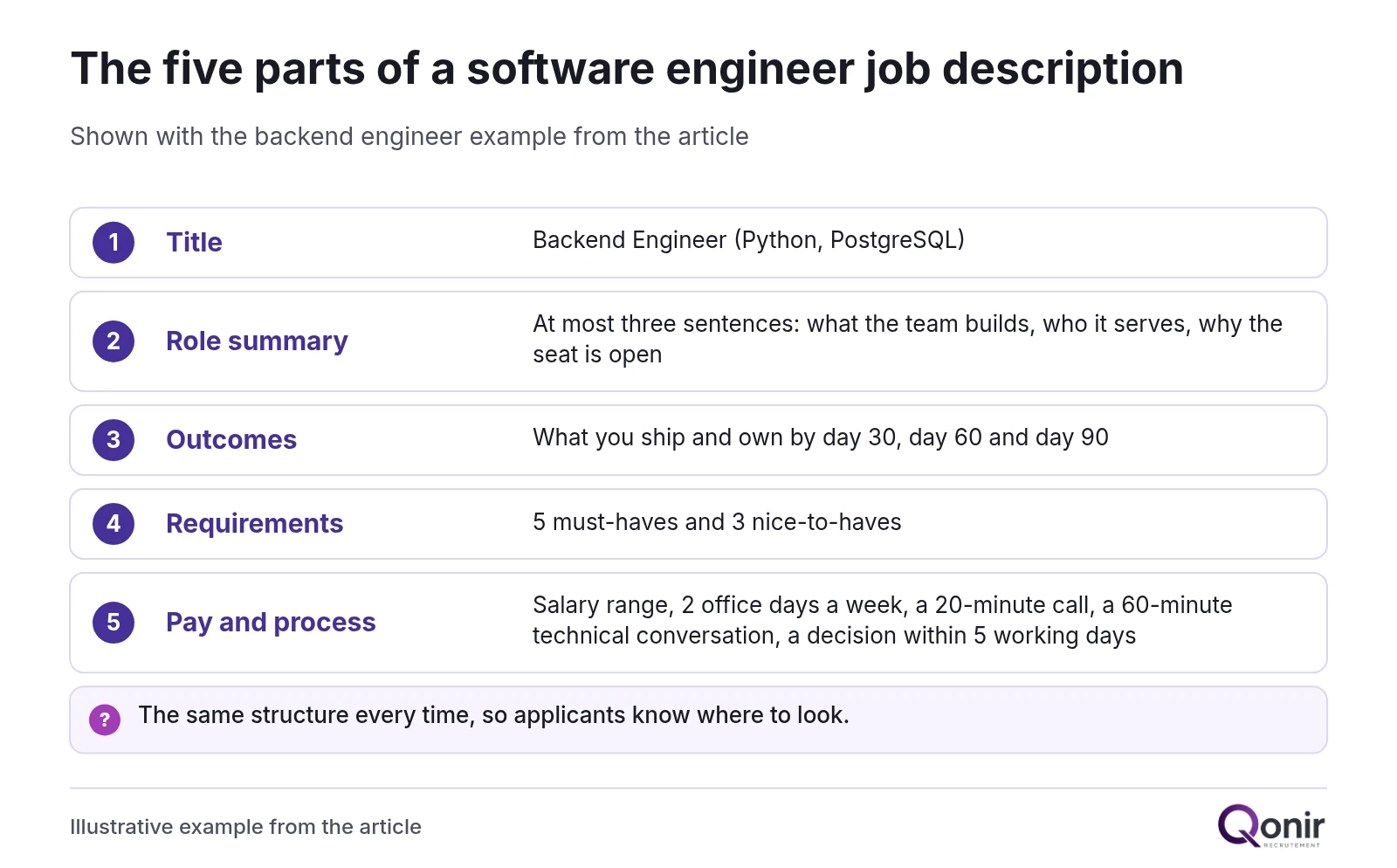
Keep the structure the same every time, so applicants know where to look and your team knows what to write.
A plain title that matches how people search, with the level only if it is real.
A role summary of at most three sentences: what the team builds, who it serves, and why this seat is open.
The outcomes you expect in the first 30, 60 and 90 days.
Requirements, split into a short must-have list and a shorter nice-to-have list.
Pay, location and process: the salary range, working arrangement, and the steps with the time each one takes.
The figure below puts the five parts side by side, using the backend engineer example from this article.
Worked example: a backend engineer for a 6-person product team
The example is illustrative, not real client data. A company with a 6-person product team needs a backend engineer to look after its API and payment integrations. The previous posting, copied from an older role, read like this: "Rockstar Backend Ninja. We are a fast-paced, disruptive startup. You must know Python, Go, Java, Node.js, Kubernetes, AWS, GCP, Terraform, GraphQL, REST, PostgreSQL, Redis, Kafka and CI/CD, plus have 8+ years of experience and excellent communication skills."
Here is the rewrite, section by section.
Title: Backend Engineer (Python, PostgreSQL).
Summary: "We build and run the API behind an online booking product used by small clinics. You will join a team of six and take over the payment integrations from the engineer who built them. The seat is open because we are growing, not because someone left."
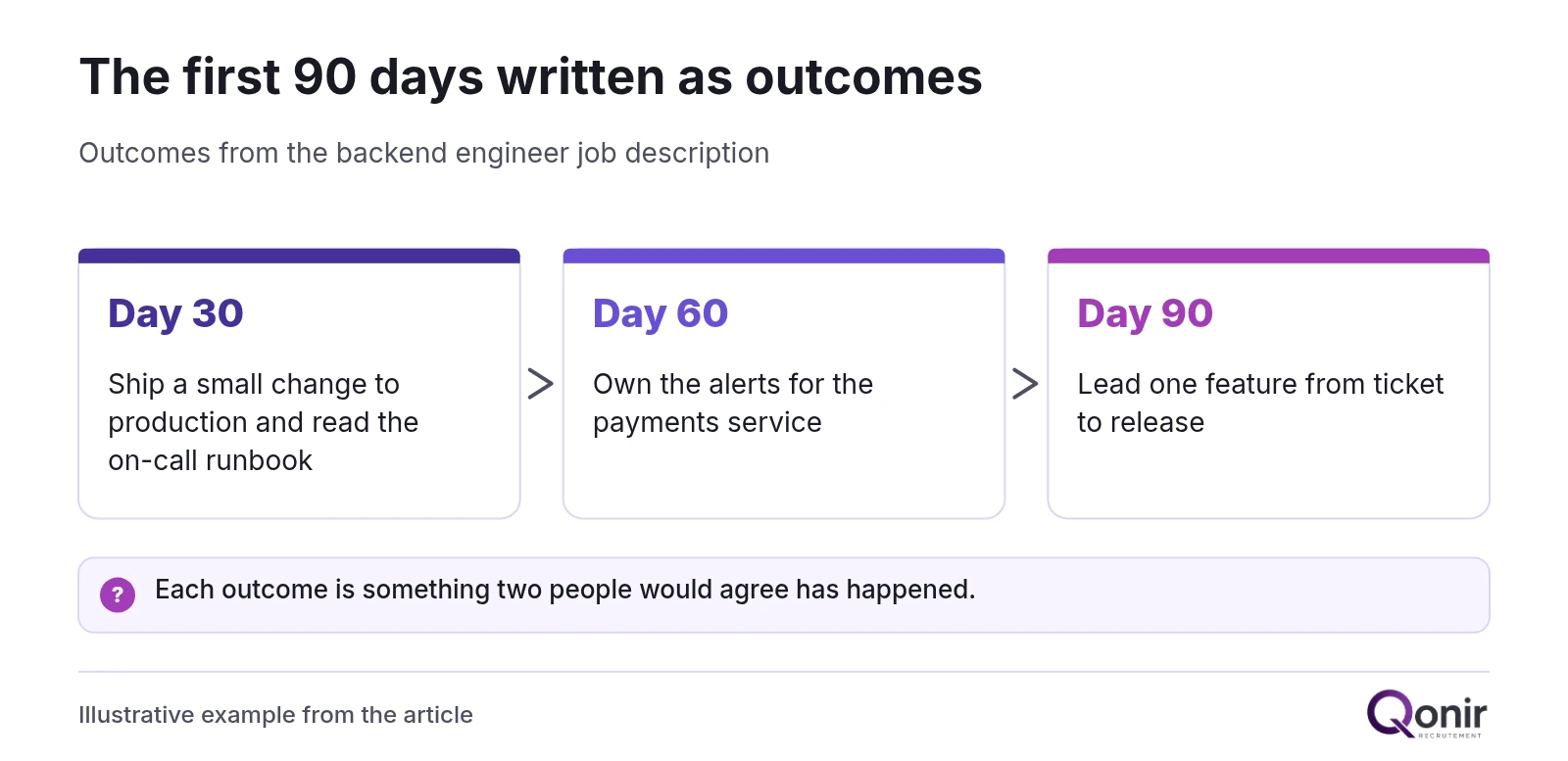
Outcomes: by day 30 you ship a small change to production and have read the on-call runbook; by day 60 you own the alerts for the payments service; by day 90 you lead one feature from ticket to release.
Requirements: five must-haves and three nice-to-haves, covered in the next section.
Pay and process: a salary range, a hybrid arrangement with two office days a week, and three steps: a 20-minute intro call, a 60-minute technical conversation, and an offer decision within 5 working days after the last conversation.
Notice what changed. The rewrite names the product, so candidates can judge interest. It names the stack in the title, so the right people find it. And it commits to a response time, so applicants know when to expect an answer.
Cut the requirements list: from 14 to 5 must-haves
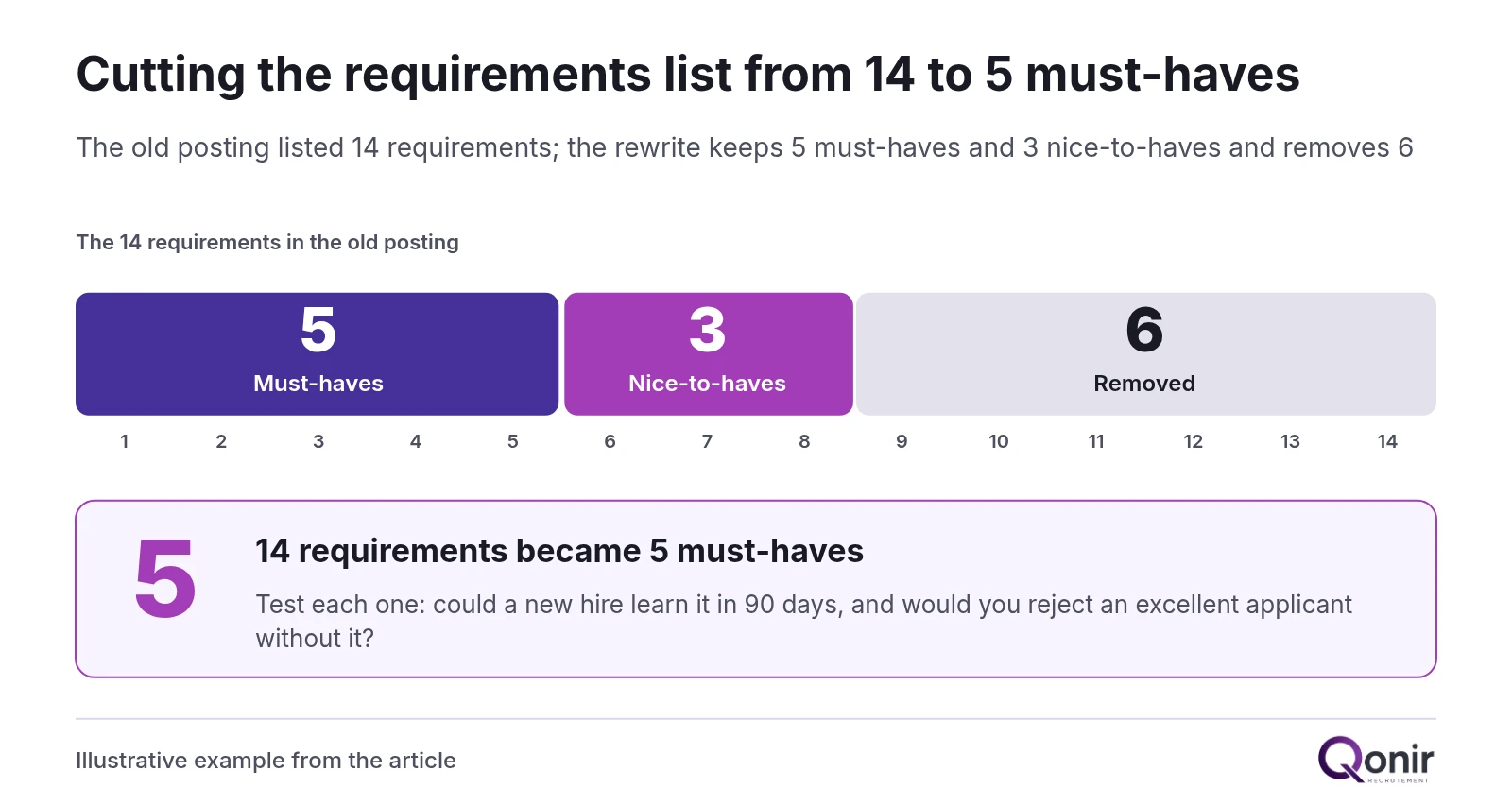
The original posting listed 14 requirements. The rewrite keeps 5 must-haves and 3 nice-to-haves, and removes 6 entirely. Here is how to make that cut yourself.
First, ask of each requirement: could a new hire learn this in the first 90 days? If yes, it is not a must-have. Kubernetes, Terraform and Kafka all fall in that category for a strong backend engineer who already knows Python and PostgreSQL.
Second, ask whether you would reject an otherwise excellent applicant who lacked it. If you would not, move it to nice-to-have or delete it.
Third, check that each must-have can be verified from a CV or a short conversation. "Excellent communication skills" cannot be verified from a CV and applies to every job, so it goes. "Has written technical documentation or runbooks that other people used" can be checked, so it stays in a concrete form.
The final must-haves for the example are: professional experience building APIs in Python, working knowledge of PostgreSQL, experience with payment or billing integrations, comfort being on call with a clear runbook, and written English good enough to explain a design decision. The nice-to-haves are Go, experience with Kafka, and previous work in healthcare software. The years-of-experience number disappears, because eight years of the wrong experience is worse than three years of the right one.
Describe the first 90 days instead of a wish list
Outcomes are the strongest part of a job description because they replace adjectives with evidence. "Self-starter" tells a candidate nothing. "By day 60 you own the alerts for the payments service" tells them what the job is, and tells you what to ask in the interview.
Write each outcome so that two people would agree on whether it happened. A simple pattern works: a time, a verb, and a visible result. "By day 30 you ship a small change to production" passes. "By day 30 you understand our architecture" does not, because nobody can check it.
Outcomes also help you screen. If the day-90 outcome is leading a feature from ticket to release, then the CV evidence you want is a previous feature owned end to end, not a long list of tools. That is exactly the kind of signal a recruiter, or a matching tool that shows its reasons, can look for. You can see how that works in practice in the Qonir guide to explainable ranking (https://qonir.com/en/blog/candidate-matching-explainable-ranking-guide).
Pay, process and wording that reduce drop-off
Three small choices change who finishes the application.
Publish the salary range. Applicants compare ranges before they invest an hour, and a missing range signals that it is either low or negotiable in an uncomfortable way.
State the steps and their length. In the example that is a 20-minute call, a 60-minute technical conversation, and a decision within 5 working days. Candidates juggling other processes will pick the one they can plan around.
Remove gendered and inflated language. Words like "ninja", "rockstar" and "dominate" narrow your pool without adding information. Say what the person does.
If you hire in several countries, write the description in the language candidates search in rather than translating it mechanically. The Qonir job description page (https://qonir.com/en/job-description) can help you produce a clean first version that you then edit with the team.
Check the description before you publish
Run this short test with someone who did not write it.
Can they tell, in one sentence, what the person will do in the first 90 days?
Can they point to the five must-haves and say how each would be checked?
Would they know how many conversations they must go through and how long each takes?
Is there anything on the page that only insiders understand?
If any answer is no, edit again. When the description is ready, publish it, then screen against the same list you wrote. Each applicant gets the same questions: which must-haves are clearly met, which are unclear, and which are missing. Teams that follow this routine spend their attention on the middle group rather than reading everything twice. If you are still choosing tools to manage that process, the guide to the best ATS for small business (https://qonir.com/en/blog/ats-for-small-business-hiring-guide) compares what to look for, and the pricing page (https://qonir.com/en/pricing) shows what Qonir costs.
Next steps
Take your current software engineer posting and rewrite it in the five-part structure. Cut the requirements until each remaining item passes the three tests above, add the 30, 60 and 90 day outcomes, and publish the salary range and process. Then compare how many applications arrive and, more importantly, how many of them match the must-haves you wrote. Fewer, better-matched applications are the goal. More articles on hiring are on the Qonir blog (https://qonir.com/en/blog).
FAQ
How long should a software engineer job description be?
Long enough to cover five parts: title, a summary of at most three sentences, 30/60/90-day outcomes, a short must-have and nice-to-have list, and pay and process. Most good ones fit on one screen.
How many requirements should I list?
Keep a handful of must-haves, around five, and a shorter list of nice-to-haves. If a new hire could learn something in the first 90 days, it is not a must-have.
Should I put the salary in the job description?
Yes. Applicants compare ranges before investing an hour, and a published range removes a common reason for dropping out.
Qonir Team
Editorial
Insights from the Qonir team on modern recruiting for SMBs.
Published · 8 min read
Related articles
Account Manager Job Description: Responsibilities, Skills and Salary
A practical account manager job description: ten core responsibilities, salary ranges from live postings, required and desired skills, career path and a template you can copy.
7 min
Recruitment Software for Small Business: The Complete Guide
Key features, GDPR, pricing and a checklist: how to choose recruitment software for a small business with 5 to 50 employees.
12 min
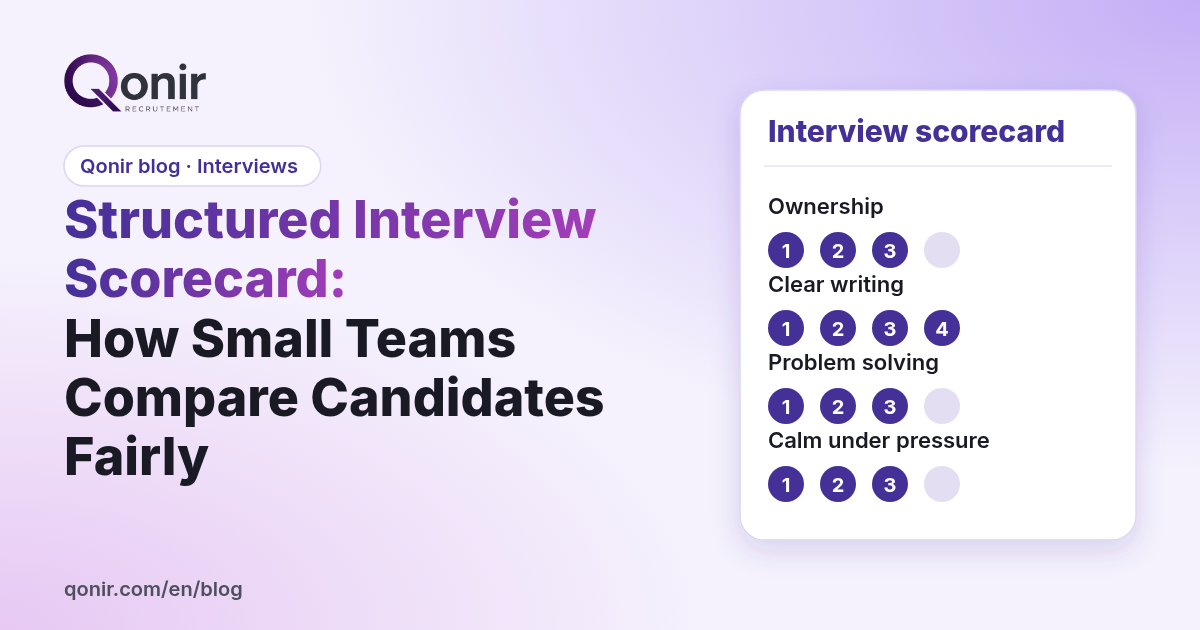
Structured Interview Scorecard: How Small Teams Compare Candidates Fairly
How to build a one-page structured interview scorecard with four competencies and a 1–4 scale, shown with three finalists for a customer support role.
8 min