
Candidate Matching: How to Rank Applicants You Can Explain
Candidate Matching: How to Rank Applicants You Can Explain. The rest of this page is that guide, written for a small team.
Qonir Team · 8 min read
A small business posts one job and gets 140 applications by Friday. Nobody on the team has time to read all of them carefully, so the first pass usually becomes a quick skim of job titles and company names. Good people get lost in that skim, and the shortlist ends up reflecting whoever read the pile on a tired afternoon. Candidate matching is meant to fix that first pass. This guide explains what candidate matching is, what it needs from you to work well, and how to run it on a real role so that every ranking can be explained to a hiring manager or to the candidate.
What candidate matching actually means
Candidate matching compares each application with the requirements of a specific role and puts the applicants in an order that reflects how well they fit. The comparison can be done by a person with a checklist, by simple keyword rules, or by software that reads the whole CV. The goal is the same in each case: spend human attention on the people most likely to succeed in the job, and make sure nobody qualified is dropped for a bad reason.
A useful match is not a single number. It is a short explanation: which requirements the candidate clearly meets, which ones are unclear, and which ones are missing. A score without that breakdown asks the recruiter to trust a black box. A breakdown lets the recruiter check the reasoning in a few seconds and disagree when the tool has misread something.
Why keyword filters fail small teams
Most teams start with keyword filters because they are built into job boards and [basic applicant tracking tools](https://qonir.com/en/blog/ats-for-small-business-hiring-guide). They are fast, but they create three problems.
They reward vocabulary rather than experience. A candidate who writes "ran the night shift" may be rejected by a filter looking for "shift supervisor", even though the two describe the same work.
They are all or nothing. A filter either keeps a CV or drops it, so a strong applicant missing one minor word disappears completely.
They hide their mistakes. Rejected applicants never reach a human, so nobody notices when the filter is wrong.
Small teams feel these problems more than large ones. With only one or two people hiring, there is no second reviewer to catch the strong profile that a rule threw away.
The four inputs a good match needs
Matching quality depends far more on what you feed it than on the tool. Before you rank anyone, write down four things.
Must-haves: the few requirements without which the person cannot do the job from day one, such as a right to work in the country, a forklift licence, or availability for night shifts.
Strengths that matter: skills and experience that make someone better at the role, such as team leadership, stock control systems, or safety training.
Evidence you will accept: what proof counts for each strength. Leading a team could be shown by a supervisor title, by a description of scheduling other people, or by a reference to training new staff.
Things you will ignore: details that should not influence the ranking, such as photos, age, school prestige, or gaps explained by caring responsibilities.
The last list is the one most teams skip, and it is the one that protects you. Writing it down makes it far easier to configure a tool, brief a colleague, and answer a candidate who asks why they were not selected.
Worked example: matching 140 applicants for a warehouse shift lead
The following example is illustrative. It shows the method on a typical role rather than reporting results from a specific customer.
A 45-person distributor of building supplies needs a shift lead for its evening warehouse team. The role supervises six pickers, owns the evening dispatch schedule, and reports stock errors to the operations manager. The advert receives 140 applications in a week.
Step 1: turn the job description into criteria
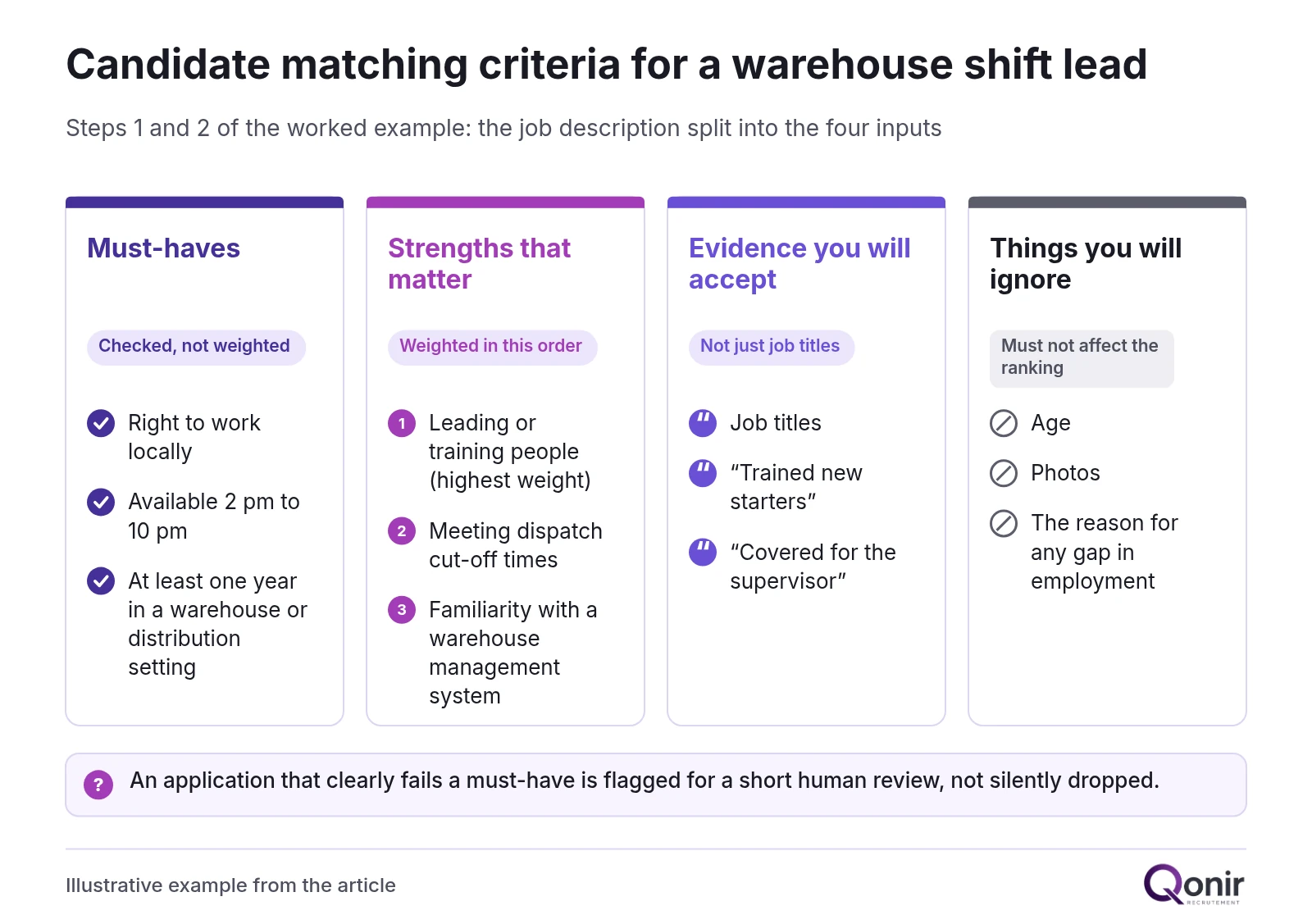
The operations manager starts from the existing job description and splits it into the four inputs. The must-haves are a right to work locally, availability from 2 pm to 10 pm, and at least one year in a warehouse or distribution setting. The strengths are experience leading or training people, familiarity with a warehouse management system, and a record of meeting dispatch cut-off times. The accepted evidence includes job titles, but also descriptions such as "trained new starters" or "covered for the supervisor". The ignore list includes age, photos, and the reason for any gap in employment.
Step 2: weight the criteria
Not every strength is equally important. The manager gives leadership experience the highest weight, because the team already knows the software and can teach it. Dispatch reliability comes second, and system familiarity third. Must-haves are not weighted at all: they are checked, and any application that clearly fails one is flagged for a short human review rather than silently dropped.
Step 3: read the score breakdown, not just the score
The matching step produces an ordered list. For each applicant the recruiter sees which criteria were met and the sentence from the CV that supports each one. At the top of the list is a candidate whose last title was "picker", which a keyword filter would have ranked low. The breakdown shows why she is near the top: her CV says she trained eight new starters and ran the late shift when the supervisor was absent. That is exactly the leadership evidence the team asked for.
Further down, an applicant with the title "warehouse supervisor" scores lower than expected. The breakdown explains it: he is only available for morning shifts, which fails a must-have. The recruiter confirms this with one short message instead of booking an interview that would have gone nowhere.
Step 4: review the borderline band by hand
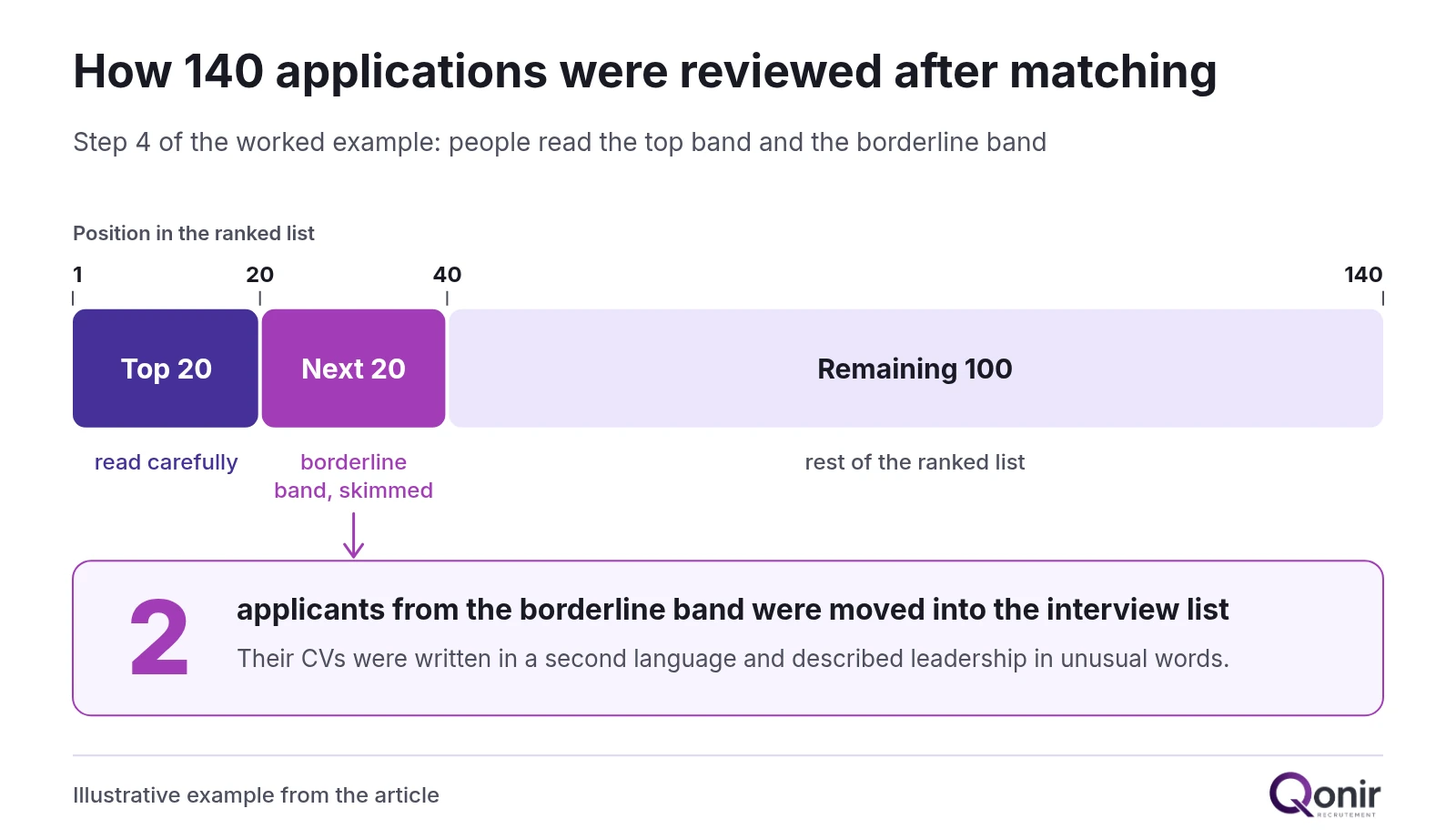
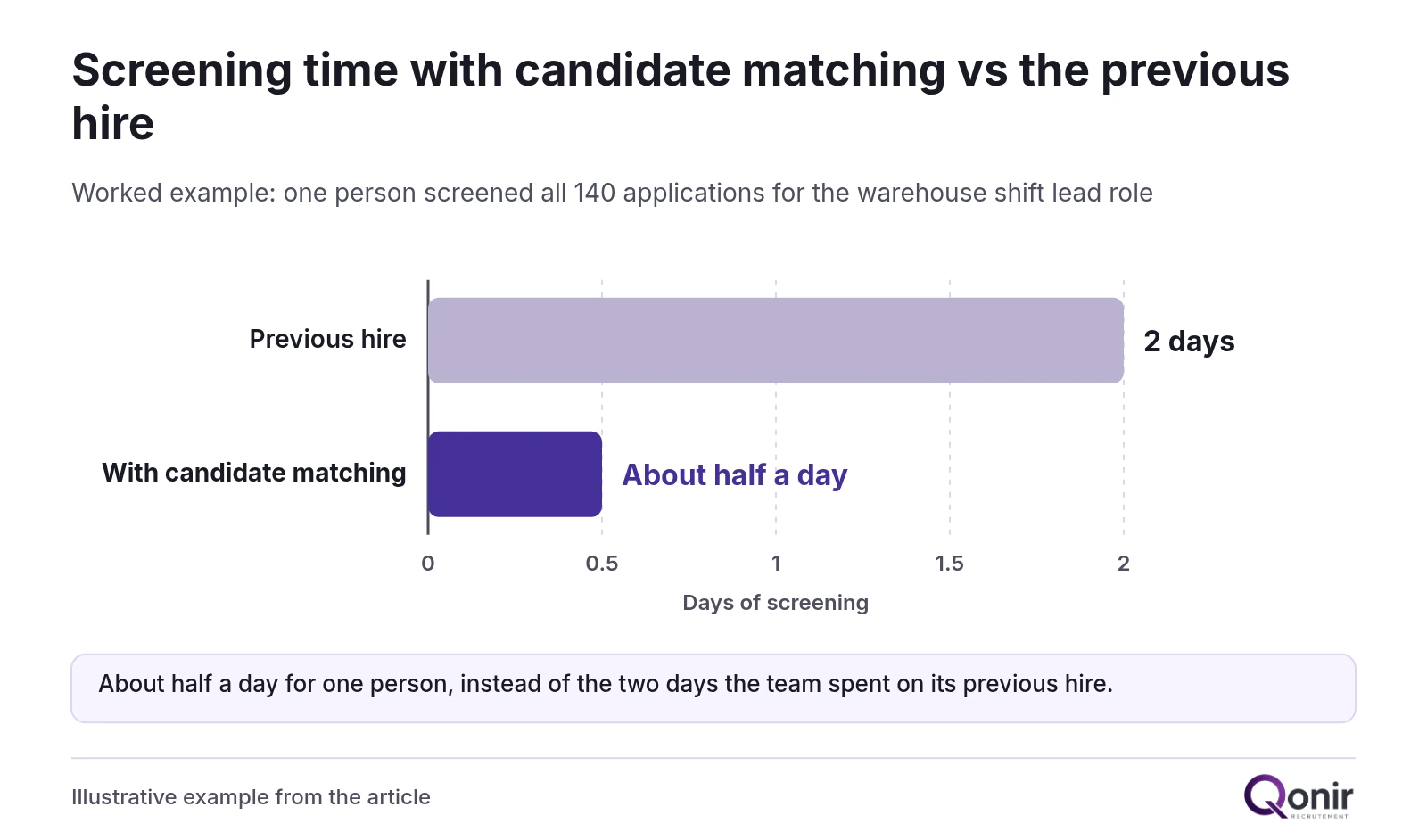
The team reads the top 20 carefully and also skims the next 20, the band where the tool is least certain. In that second group they find two applicants whose CVs were written in a second language and described leadership in unusual words. Both are moved into the interview list. Total screening time for the 140 applications is about half a day for one person, instead of the two days the team spent on its previous hire.
What the team learned
The shortlist included people the old keyword process would have dropped, and every decision came with a reason the manager could repeat. When one rejected applicant asked for feedback, the recruiter could answer honestly in two sentences: the role needed evening availability, and his application said mornings only.
How to keep matching fair and explainable
A ranking tool can repeat the biases of the people who configured it, so fairness has to be designed in rather than assumed.
Keep criteria tied to the job. Every must-have and strength should be traceable to a task in the job description.
Remove signals you do not need. Hide or ignore photos, dates of birth, and other details that should not affect the decision.
Check the middle of the list. Errors cluster where the tool is least confident, so a short human pass over the borderline band catches most of them.
Keep a record. Store the criteria, the weights, and the reason for each shortlist decision. This helps with audits and with candidate questions under data protection rules.
Review after each hire. If the person you hired was ranked low, ask why and adjust the criteria for the next role.
Mistakes to avoid
The most common mistake is writing too many must-haves. Every extra hard requirement shrinks the pool and often excludes people who would learn the missing skill in a week. Keep must-haves to three or four.
The second mistake is copying requirements from an old advert without checking them. A role changes over time, and criteria written for the previous person in the job may not match what the team needs now.
The third mistake is treating the top score as the answer. Matching is a way to order your attention, not a replacement for an interview. The final decision still belongs to people who have spoken to the candidate.
Where to start this week
Pick one open role. Write the four lists in a shared document and ask the hiring manager to agree to them before anyone reads a CV. If your job description is out of date, rebuild it first using a [structured job description template](https://qonir.com/en/job-description). Then run your applicants through a [matching step that shows its reasons](https://qonir.com/en/product/matching), read the top band and the borderline band, and note how long the screening took. One role is enough to see whether the method works for your team. If you want to run this inside Qonir, the [pricing page](https://qonir.com/en/pricing) lists what each plan includes.
For more practical guides on screening and small-team hiring, browse the [Qonir blog](https://qonir.com/en/blog).
FAQ
What is candidate matching?
Candidate matching compares each application with the requirements of one role and orders applicants by fit. A useful match shows which requirements are met, unclear, or missing, not just a score.
Is candidate matching the same as keyword filtering?
No. Keyword filters keep or drop a CV based on exact words. Matching weighs evidence across the whole CV, so someone who describes the same experience in different words is not lost.
How many must-have criteria should a role have?
Usually three or four. Each extra hard requirement shrinks the pool and often excludes people who could learn the missing skill quickly.
Does matching replace interviews?
No. Matching orders your attention during screening. The hiring decision still belongs to the people who interview the candidate.
Qonir Team
Editorial
Insights from the Qonir team on modern recruiting for SMBs.
Published · 8 min read
Related articles
Account Manager Job Description: Responsibilities, Skills and Salary
A practical account manager job description: ten core responsibilities, salary ranges from live postings, required and desired skills, career path and a template you can copy.
7 min
Recruitment Software for Small Business: The Complete Guide
Key features, GDPR, pricing and a checklist: how to choose recruitment software for a small business with 5 to 50 employees.
12 min
Structured Interview Scorecard: How Small Teams Compare Candidates Fairly
How to build a one-page structured interview scorecard with four competencies and a 1–4 scale, shown with three finalists for a customer support role.
8 min